
Finding Alignment in 2026
Making the personal political through small, hopeful steps

As always, January brings the feeling of a clean page and untapped potential. Following weeks of holiday, where we have had time to rest, recover, and reflect on the previous twelve months, I begin the new year feeling hopeful. Even though the world feels like we are two minutes from catastrophe at any given moment, something about January offers a reset, and an opportunity to approach the next year differently.
My sense of hopefulness is resilient and not unfounded. I wrote in one of my earliest Substack articles about the importance of hope, and it is a pervasive theme of my new book. Hope is not an abstract, aspirational concept. Nor should it be dismissed as naïve idealism. Constructively applied, hope needs to be pragmatic. It shouldn’t shy away from the scale of the challenges we face but should remain immune to the unhelpful and defeatist cynicism that can set in when it is absent (Jamil Zaki’s book Hope for Cynics makes a compelling case for this). Hope is made active in small, concrete steps: nudges towards change that accumulate and, in time, gain energy and momentum of their own.
One of the small steps I like to support my annual hopefulness, is to set a word or intention for the year. My good friend Rowin has asked me my word for years, and come January we share notes on our chosen one and its significance. I find I ask people theirs as the year begins. A friend and colleague decided this year she will ‘live dangerously’, and another of my good friends has chosen the word ‘nourish’, ensuring her year is guided by prioritising people, connections, and activities that nourish her. It’s such a small step but sets a tone, and a point of focus.
The benefits of ‘expansion’
Last year my word was ‘expansion’. It sounds slightly vague and mystical perhaps, but my intention was to shake myself out of my comfort zone and agree to saying ‘yes’ to new adventures and opportunities, no matter how new and scary or different they might be.
It meant I said yes to camping in Australia, despite a deep anxiety that all of Australia’s wildlife is trying to kill me. Turns out finding a leech sucking blood in your sock shifts your focus away from giant spiders. And sleeping under a sky bursting with stars, and waking up 100 metres from pristine beaches, wild kangaroos, and the song of kookaburras more than makes it worth it. I said yes to regularly riding pillion on my partners’ motorbike, though he had to ease me in gently to speed and freeways. It meant deciding to return to music again, even though it feels hard to start from scratch and go through the process of being an absolute beginner and getting things wrong. As a result, I made an impulse purchase and am now learning to play bass guitar, so I can connect with my innate desire to bop or shimmy to every rhythm I hear. It has also involved getting out the watercolours and art materials so I can fulfil a dream of being an artist (even a very amateur, bad one). And it meant saying yes to finally finishing the book, overriding perfectionist tendencies and uncertainty, and getting it out into the world.
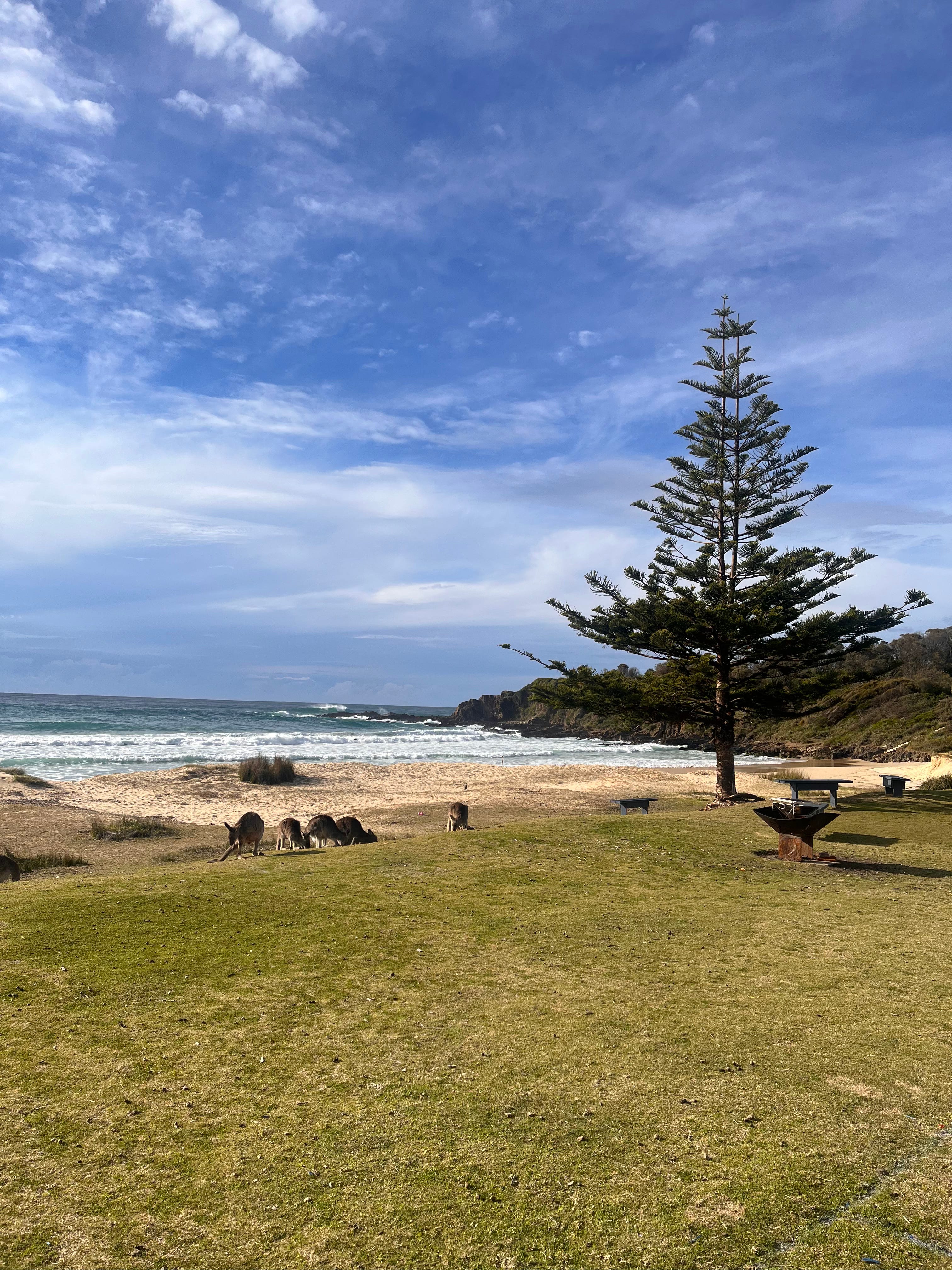
Kangaroos and pristine beaches in a year of ‘expansion’
The immediate implications of my efforts to be more open to experiences and discomfort will not change the world, though they have transformed mine. I feel more curious about the passions that drive people, and the skills and character strengths that help them realise their ideals and visions of a meaningful life. I take more time to observe and understand others and seek out more new things as I enjoy that sense of my world growing larger and richer and more varied. Such learning inspires me to adopt new habits, and to become more willing to sit in spaces where I do not know what I am doing, and do not have all the answers. That has to help the effort of becoming more empathetic, however imperfect the progress.
This year my attention is now focused on ideas of ‘alignment’ and ‘authenticity’. How do we live in alignment with our values? Are we clear on what they are and why they are so important? And how do we show up as our most real and authentic selves? As if to nudge me further, today’s daily quote was from Epictetus ‘First say to yourself what you would be; then do what you have to do’.
Integrity requires courage. It compels us to stand up for what we believe, for how we want to live, even when that is hard. Such integrity may mean people are disappointed, that you have to withstand criticism, or be misunderstood. Arguably it is, initially at least, at odds with an easy life, or the passivity of going with the flow. Yet I suspect it is a far easier way of being if people know who you are, and what you stand for, without equivocation.
My grandparents inspired me growing up because of their own deep integrity. My grandfather’s favourite poem was Invictus by William Ernest Henley. It captures, for me, that importance of inner sovereignty, of withstanding the challenges without caving in to external pressures, or becoming someone you are not. No doubt, as humans we can all make mistakes or temporarily lose our way, but as a guiding compass, alignment and integrity point us towards the things that really matter and help us recalibrate and make amends when we lose our way. The poem itself focuses on the individual, but we also need it in the relational, in how we connect with one another.
Making the Personal Political
Such values matter as much in our personal lives as in our politics. How we live our lives privately shapes what we tolerate and expect publicly.
We are in urgent need of leaders who can match vision and promises of change, with the skills, capacity, and intention to deliver on them. So many people talk of how they will transform societies, but what are they doing in practical terms to realise it?
It is a theme that recurs throughout my writing. Empathy is vital but alone it is not enough. Instead, the concepts of integrity and alignment are integral to how I define it. For empathy to be effective it has to be matched with words and actions that give it meaning and credibility. Empty or performative empathy becomes just platitudes of understanding if not matched by meaningful efforts, behaviours, and actions that reinforce it and give it power.
Integrity in politics involves the risk of being unpopular for what is right. It means standing your ground when critics seek to silence you. And it requires us to challenge orthodoxies and ideas that no longer serve us to find something that is more in alignment with the societies, the communities, and the countries we want and need to thrive. There are many politicians who model such behaviour and such character, but we need it to become an overwhelming norm, and not an exception.
Over the coming weeks and months, I’ll be writing more on what these ideas look like in practice, for our leaders and for ourselves, and why such efforts and changes are so needed.
Do you have a word or intention for 2026? What small but meaningful steps can you take to create positive ripples and put hope into action?